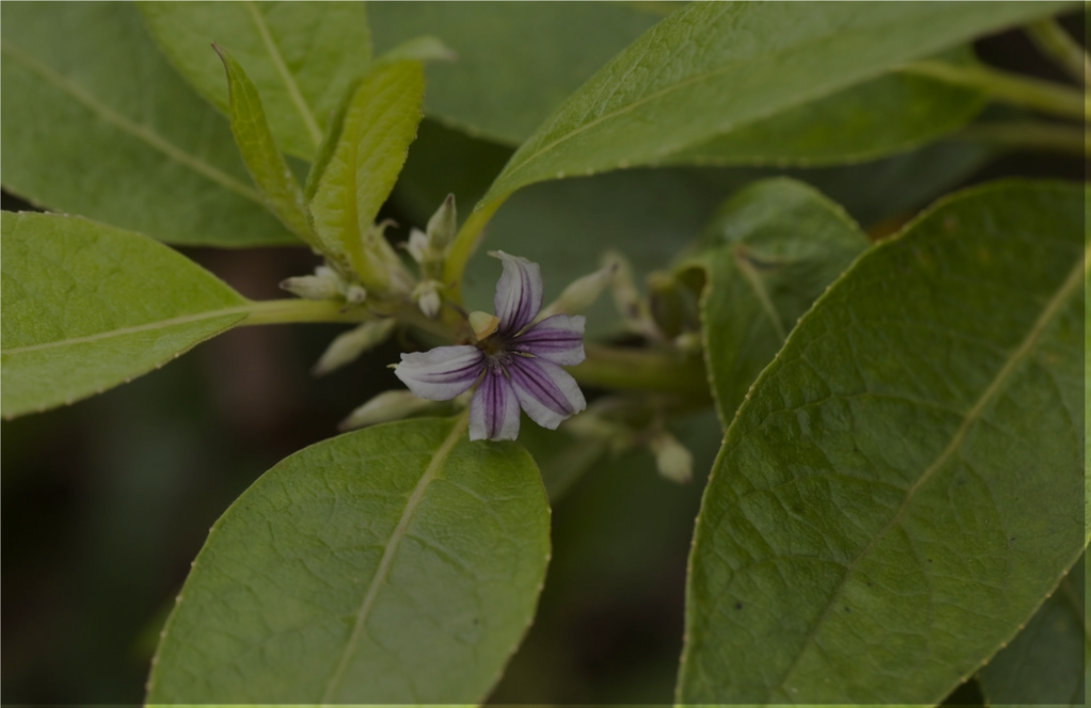


Trematolobelia

Zahlbr. ex Rock (1913)

This name is accepted

Kingdom: Viridiplantae Phylum: Magnoliophyta Class/Clade: Eudicot-Asterids Order: Asterales Family: Campanulaceae Genus: Trematolobelia

Description

Key Characters:

Growth Form: Pachycaul treelets of the “holttum” architectural model (cf. Hallé & Oldeman, 1970; Hallé et al. 1978), 0.6–4 m tall, sometimes epiphytic on larger trees; plant semelparous (very rarely iteroparous via basal offshoots), the shoot pliestesial and hapaxanthic; latex white, viscous.

Stems: Stem 0.5–2 cm diam. below the apex, solitary and unbranched, erect, leafy only at apex, glabrous or densely short–pubescent, cicatrices raised, corky, semi–circular, shallowly obdeltate, shallowly obtriangular, widely obtrullate, narrowly transversely rhombic, or narrowly transversely elliptic with a single central vein scar, closely packed in a helical pattern and long persistent, pith soft, broader than the lignified cortex toward apex but narrowing toward base as the cortex increases in thickness, becoming hollow with age, vessel elements 500–770(–1135) μm long, 50–65(–146) μm diam. helical thickenings absent, the perforation plates simple, the pits circular, 6–7 μm diam., libriform rays septate, 750–1015 μm long, 29–42 μm diam. the walls 3–6 μm thick, axial parenchyma very scarce, rays 1.5–4 mm tall, 3–12 cells wide (Carlquist, 1969).

Roots: Roots mycotrophic via vesiculararbuscular mycorrhizae (Koske et al. 1992).

Leaves: Leaves simple. Alternate, forming a dense spherical, oblate, or cylindrical apical rosette. Blades oblanceolate, oblong, narrowly oblong, elliptic, narrowly elliptic, or linear. Apex acuminate, acute, or rarely obtuse. Base attenuate, sometimes quite petiole-like, in other cases the differentiation of a petiole very indefinite and the leaf clearly sessile. Surfaces glabrous; blades coriaceous. Margins entire or crenulate, sometimes undulate, with few to several intramarginal callosities distally. Stipules absent.

Flowers: Flowers in inflorescence a series of 4–12 pedunculate bracteate horizontal secund racemes from the upper leaf axils (a single terminal erect raceme in t. singularis), the axes glabrous or densely shortpubescent, each 10–60–flowered over its life, but seldom more than 4–10 open at any one time; peduncle usually equaling or shorter than the rachis, densely to sparsely covered with glabrous reduced leaves (sterile bracts) decreasing in size acropetally; floral bracts conspicuous, shorter than to somewhat longer than the pedicels, glabrous; pedicels bent above the middle, stiff, bibracteolate in the basal half, glabrous. Flowers tetracyclic, bisexual (perfect), protandrous, zygomorphic, epigynous, pedicellate, resupinate, ornithophilous, large. Calyx synsepalous; tube glabrous, adnate to the ovary, forming a hemispheric, campanulate, oblate, obovoid, ovoid, or ellipsoid appendicular hypanthium 1/12–1/6 as long as the corolla; lobes 5, valvate, triangular, oblong, linear, ovate, lanceolate, or narrowly elliptic, 3/5 as long as the hypanthium to nearly 3 times as long, the dorsal sometimes a bit longer than the ventral, erect or ascending (spreading in T. kauaiensis), caducous from the young fruit, minutely auriculate in T. auriculata, the margin entire (rarely sparsely denticulate and/or ciliate toward apex), the apex round, obtuse, acute, or acuminate and sometimes apiculate. Corolla sympetalous, zygomorphic, subbilabiate (unilabiate in T. kauaiensis), glabrous, pink, red, white, or yellowish green suffused or streaked with pink; tube arcuate to gently curved, laterally compressed, tallest about the middle and contracting towards the mouth, 3.4–8.8 times longer than tall, dorsally cleft nearly to base; lobes 5, valvate, linear, monomorphic, acuminate or acute at apex, the dorsal pair spreading or recurved horizontally or dorsally in the subbilabiate species, 3/5 as long as the tube to half again its length, the three ventral lobes connate for 56–86% of their length, forming a deflexed flat trifid lip shorter than the dorsal lobes. Stamens 5, antisepalous, connate distally for most of their length, strongly (only scarcely in one species) exserted, emerging from the dorsal corolla slit above or between the dorsal lobes; filament tube suberect or slightly deflexed, 3.1–5.5 times longer than anther tube, pubescent toward apex (rarely glabrous); anther tube pubescent at base (rarely glabrous); dorsal anthers longer than the ventral, overhanging the orifice of the tube and somewhat occluding it; ventral anthers with tufts of white trichomes at apex. Pollen grains 41–44 μm polar diam. 27–30 μm equatorial diam. prolate, tricolporate, the exine shallowly and minutely reticulate (Selling, 1947). Ovary inferior, 2-loculed, adnate to the hypanthium, flat at apex; placentae axile; ovules numerous; style 1, slender, terete (cylindrical), with a ring of stiff white hairs near the apex; stigma 2-lobed, the lobes appressed and non–receptive as the style grows through the anther tube, pushing out pollen, after which the stigmas spread and become receptive.

Fruit: Capsules compressed globose; oblate; broadly ellipsoid; or hemispheric; umbonate at apex; exocarp and parenchymatous portions of the mesocarp deliquescent; leaving a tightly enshrouding reticulum of sclerenchymatous bundles; endocarp papery; rupturing irregularly at base; releasing the seeds; which are discharged through the 5–15 irregular pores in the sclerenchymatous mesocarp. Seeds winged; oblong or elliptic; compressed; honey– or chestnut–brown; the relatively broad wing paler; seed coat striate–reticulate (Type C of Murata; 1992).

Ploidy: 2n = 28

Habitat: These species are restricted to wet windswept habitats; typically ridge crests and summit bogs; on the six largest of the Hawaiian Islands.

Elevation Range: 610–1730 m.

Historical Distribution

Uses and Culture

USES

Natural History

Island Status

Dispersal Agents


Pollinators

Bibliography

Name Published In: Coll. Hawaii Publ. Bull. 2: 45 (1913)

Other References

Lammers, T. G. (2009). Revision of the endemic Hawaiian genus Trematolobelia (Campanulaceae: Lobelioideae). Brittonia, 61(2), 126-143.

Occurrences

SNo. Scientific Name Scientific Name Authorship Locality Habitat Basis of Record Recorded By Record Number Island Source Date